Chloé Zhao adapts from Maggie O'Farrell's 2020 bestseller.
The drama circles the death of Shakespeare's eleven-year-old son, Hamnet.
Starring Jessie Buckley and Paul Mescal, the film has eight Oscar nods.
Hamnet Review | Jessie Buckley Is Shattering In Chloé Zhao’s Rich Grief-Soaked Drama
Also starring Paul Mescal, the Oscar-nominated film travels through the shadow of a death in the Shakespeare family.

Summary
In Hamnet, Chloé Zhao performs the deepest, most radical act of empathy, merging screen, stage and text in the ultimate transcendent projection. Adapting from Maggie O’Farrell’s eponymous 2020 Women’s Prize for Fiction-winning novel, she listens to a devastated mother’s heartbeat and connects it to a communion for solace. Hamnet opens from an intimate place and fans out into a collective consolation. Zhao begins very much in line with O’Farrell’s vision, making tidy omissions, doing away with time jumps and being more steadily focused on the relationship between Agnes (Jessie Buckley) and her husband, William Shakespeare (Paul Mescal). The lens is firmly on Agnes, the wife and mother entirely sidelined in history but whose interior life gains primacy in this telling.

Still Focus Features
Zhao and O’Farrell, who’s co-written the screenplay, take the footnote of an eleven-year-old child the couple lost, Hamnet (a revelatory Jacobi Jupe) and mine art’s cathartic function. The film quickly dispenses with the couple’s immediate, magnetic courtship. Agnes and William couldn’t be more different, but they are headily drawn to each other. Hamnet is deeply ensconced in the ecological and feminine. Both these energies are held as restorative—an antidote to a wounded, rushing world. Agnes is a creature of the wild. She summons hawks out of a shrouded sky. When she first gives birth, she chooses intense privacy in a grove.
Still Focus Features
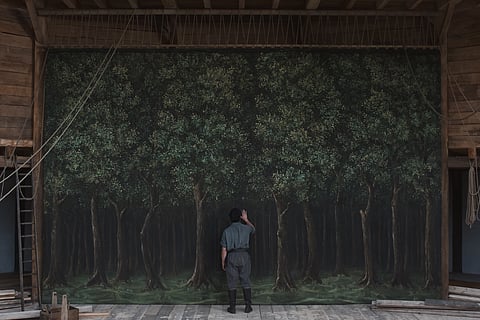
Zhao keeps returning to a gaping tree hole, Initially, it’s a passing curiosity for Agnes. Later, it haunts her as the loss that envelops her and acts as an interstice between the living and dead. Zhao keeps the earth at her elemental bedrock. In the novel, Agnes is suffused with a gentle witchy air. She’s viewed as an eccentricity. Zhao hints at it but is more inclined to tie it within Agnes’ deep, primal bond with nature. Her earthy red dresses keep the thread alive. The forest calls out to Agnes. In a sense, the film isn’t just about the child’s loss, but access to the untamed natural world that Agnes is increasingly deprived of amidst William’s financial ascent. She’s bemoaning her own self that appears profoundly shifted. In a novel expansion, Zhao cleverly fashions the stage’s backroom as the shadowy liminal space where souls linger. Stranded there, Hamnet awaits his mother’s go-ahead. The tree’s hollow and the backroom collapse into an eternal, ever-widening void.
Advertisement

Still Focus Features
Agnes is the one who pushes Shakespeare to pursue luck with finding patronage and staging his plays in London. She knows she’ll lose him if he doesn’t go. This generosity also means his absence in times when she needed him the most. Shorn of that, she spirals somewhere it seems no return is possible. Hamnet gradually portends the emotional release, the healing. Bereavement is a long, merciless road whose steep bends don’t just go away with time. The minute you see grief out of view, it hits back with greater, all-consuming force. Buckley submerges completely. As does Mescal. They embody grief in its very marrow.
Still Focus Features
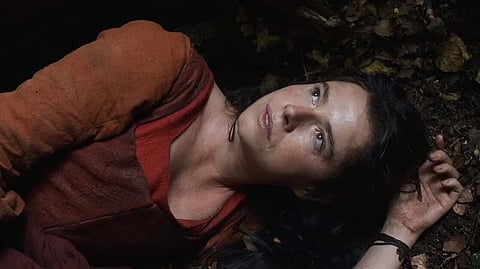
But Zhao stays with Agnes. Buckley portrays her irrevocable shifts after loss with detail and rigour. Her body and self are spent. Battered by life’s arbitrary cruelties, she can no longer walk even. Buckley projects a leaching out of vitality itself. Even as Agnes’ material reality improves exponentially, her emotional essence stays ruptured. She withdraws into the most intangible recesses, shutting out love, care and the world. To William, she becomes as impenetrable as she has ever been. She’s angry with him for seemingly moving on whereas she has been wholly defined and hemmed in by the tragedy. William wasn’t even around when their son passed. That’s her grouse. Zhao also excises the novel’s suggestions of his affairs in London. Agnes was witness to Hamnet’s desperate pain, which has now embossed itself on her every breath. She can’t forget how he groped to clutch onto life’s remaining shreds, her own acute helplessness as she saw him die.
Advertisement
Fittingly, Zhao honours Agnes’ grief with due time and patience. Even as Agnes is expected to pull herself together, her mourning is assumed to resign itself to serve the image of a responsible, emotionally tempered mother. She fulfils the role, nevertheless something deep within her has dislodged. Zhao melds into the passing years a sort of time-erasing quality. Agnes is emotionally left behind. Time since has been static. Agnes struggles to find hope and purpose. Buckley captures a woman so hollowed out by grief she’s severed from living itself. Zhao makes us inhabit every pinprick of her sustained pain. Somehow, she’s able to sashay past fuss over recreating a historical period drama, invoking instead an intensely inward work resolutely aligned with her familiar pastoral worldview. Brooking its pace, Hamnet ultimately turns to the Bard’s own Hamlet—his hitherto unfelt grief that has been channelled in his writing. It’s in the art, so much of which she herself championed into actuality, where she confronts the barest outlet for her loss, its unloading. Zhao orchestrates this interface with stunning grace, Buckley’s face a map of splendid inner transformation. For a film this drab, there is the parting promise of hope and redemption.
Advertisement
Published At: