Abracadabra competed in the Generation Kplus section at the Berlin Film Festival 2026.
The short film is written and directed by Amay Mehrishi.
Mehrishi explores a friendship at a shifting point.
Abracadabra Review | Amay Mehrishi’s Perceptive Short Film Zooms Into An Eroding Friendship
Berlinale 2026 | A physical gesture shifts everything between two best friends in this Generation Kplus title.

Summary
The best short films wield a tremendous grip over a sense of time, rhythm and deep evocation. They bring us to bear our own memories and experiences and project those onto their plane of fleeting depiction. Within its brief flash, a great short film burns itself into our submerged aches. Premiering at the Berlin Film Festival’s Generation Kplus section, Amay Mehrishi’s short film, Abracadabra, looks into the split in a childhood friendship assumed as unshakeable. Agastya (Advay Pradhan) and Naman (Arsh Victor Suri) are best friends tucked away in their own private world. However, there comes a moment when the most solid equations are tested. It becomes the point where it either frays or grows stronger. Trust either fractures or redoubles.

Within the friendship, Mehrishi sneaks in queer undercurrents. It’s not underlined, but you can feel it float just above the surface. The rupture slings from a gesture turning too physical. Naman pulls away when Agastya puts his head on his shoulder. Given their deep friendship, this might not have been particularly new body language. But it’s also a tricky transitional moment where innocence is shed and one awakens to implications. In a sudden temperature change, their comfort is replaced with awkwardness. There’s flinching and retreating, the easy conversation dropping silent. How far can this relationship travel? Both sense the change instinctively, but it is Naman who promptly draws boundaries.

Still Aditya Sharma
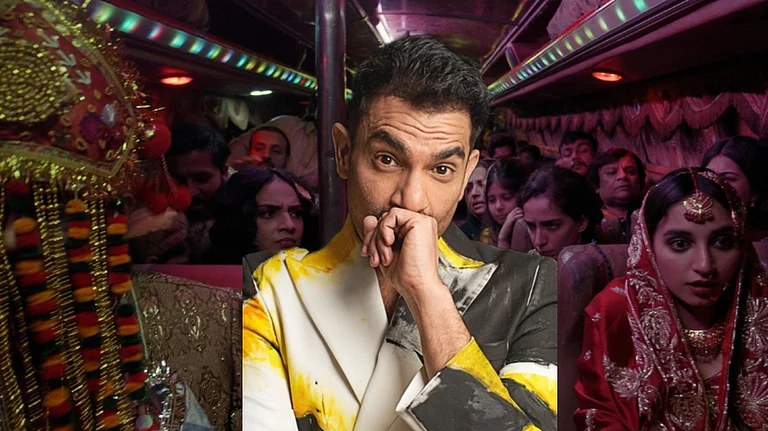
On the school bus after school, the effects are immediate. Naman sits with a girl—a break from routine—but he feigns being unaffected. He makes the dramatic change casual. Neither does he meet Agastya’s gaze with familiar warmth. His cues are silent, emphatic and punishing. Agastya’s stabs of envy strain to gather itself, recede with dignity intact. The friendship suddenly seems sloughed off into that of rank strangers crossing paths who don’t have anything to say to each other. This indication appears clear but Agastya isn’t ready to face it yet.
With Agastya’s perspective gaining primacy, the film is fully carried by Advay Pradhan’s quietly devastating, minutely rendered turn. The smallest of micro expression feels tangible in his performance. There’s disappointment, hurt, betrayal, the crippling feeling of being utterly lost in the distance set by his closest friend. Unprepared for such a situation, Agastya flails to find comfort in his own skin. He’s lost, struggling with inadequacy. Sans his best friend, he’s cast ashore, at sea amidst conformity. Mehrishi’s script mines tiny flashpoints, like an assertion on boys being handsome, not “beautiful”, or the bus driver lobbed a stray Islamophobic insult.
Advertisement
A pivotal conversation with a senior hints at the need for Agastya’s reassembling in his own solitary likes and dislikes. Does Agastya even know himself without the shade of Naman? Shorn of him, Agastya must now discover himself. Set almost entirely on one bus ride, Abracadabra uncloaks an internal landscape. Mehrishi smartly shifts between collective energies and Agastya’s peripheral tentativeness grappling to ease itself in a new configuration. Away from his comfort corner, he’s the proverbial fish out of water amidst bullying, louder classmates and seniors.
Along with his editor Ananyaa Gupta, Mehrishi plumbs an early heartbreak in all its wrangling confusion and incomprehension. The brakes being pulled on a friendship thought as unbreakable can be utterly shattering—as painful and life-altering as the end of a romance. This is a customary rite of passing in growing up. Nevertheless, Mehrishi is able to latch onto its sheer magnitude. When someone asks Agastya who he has a crush on, his gaze immediately shuttles toward Naman. Mehrishi and his DP Aditya Sharma wind with Agastya around the bus crowd, as he edges toward and moves farther from his former best friend. It’s in this spatial fluctuation that the film finds its sobering pulse and emotional reality. The eponymous mock-magic trick becomes a conduit for anger at being snubbed—an insistence on one’s trampled feelings being counted. Even as Agastya pretends to be indifferent, he can’t resist stealing a glance at Naman. Watch the way his face slightly falls when Naman talks of a probable girlfriend. The film trusts its young actors to cut through the motion, trace repressed yearnings and misgivings. Abracadabra feels intimate and volcanic in its latent heave. Mehrishi has made something small yet immense in its subtle understanding.
Advertisement
Published At: