The film tackles sexual violence with urgency and emotional weight, but struggles with narrative clarity and character arcs.
Kani Kusruti, Mohammed Zeeshan Ayyub, and Basant Mahavir Singh deliver strong performances, while several veteran actors remain underused.
Beyond its flaws, the film underlines the need for early conversations about consent and sex education in society.
Assi Review | Anubhav Sinha-Taapsee Pannu’s Courtroom Drama Asks Crucial Questions But Falters With Storytelling
Important conversations on consent and safety emerge through the film, even as the filmmaking dwindles structurally.

Summary
Directed by Anubhav Sinha and co-written by him along with Gaurav Solanki, Assi is positioned as an investigative courtroom drama rooted in the reality of sexual assault cases in India. The film opens with a hard statistic: roughly eighty reported assaults a day, once every twenty minutes. It is a number meant to disturb, and it does. But once the shock settles, the question becomes whether the storytelling sustains that force.
At its core, Assi follows Parima, played by Kani Kusruti, who survives a brutal assault and finds herself navigating hospitals, police stations, and courtrooms. The film stays tightly focused on this single case, which initially works in its favour. There is clarity. There is emotional weight. The trauma feels specific rather than symbolic.

A Still Of Kani Kusruti YouTube
Yet, for a story that claims to look beyond statistics, much of what lies beneath remains frustratingly unresolved.

The courtroom battle is led by Raavi, played by Taapsee Pannu. Her scenes are dramatic, sometimes intensely so. However, there is almost nothing offered about her personal history or inner motivations. She argues fiercely, but the emotional foundation of her character is left unexplored. In a film that demands psychological depth, that absence becomes noticeable.
Kusruti, on the other hand, anchors the film with restraint. She conveys trauma without theatrics. Her silences speak. Mohammed Zeeshan Ayyub complements her with a quiet performance as the husband, torn between rage and helplessness. Their scenes together are effective, though there is a lingering disappointment that the film does not give them more shared screen time to fully explore the emotional rupture within their marriage.

A Still Of Mohammed Zeeshan Ayyub YouTube
Basant Mahavir Singh, as the defence lawyer, is also compelling. He brings sharpness and conviction to the courtroom exchanges. Ironically, some of the most engaging stretches of the film come from his arguments.
Advertisement
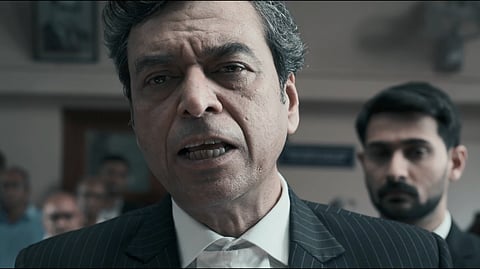
A Still Of Basant Mahavir Singh YouTube
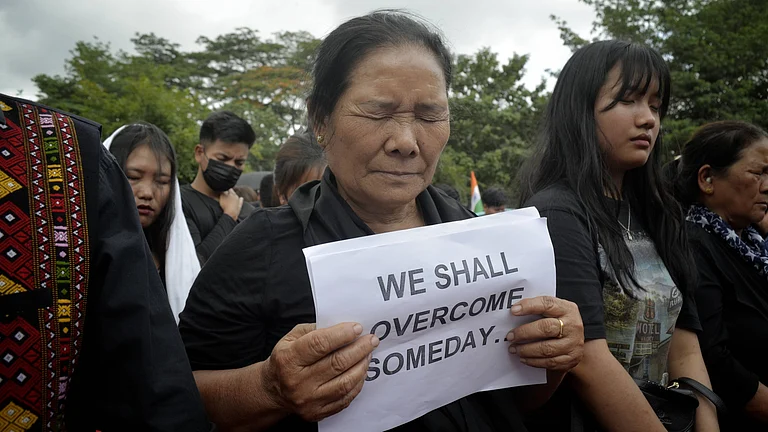
Where Assi falters significantly is in its supporting cast and character arcs. Veterans like Naseeruddin Shah, Seema Pahwa and Supriya Pathak are present, but their talent feels largely wasted. Their characters appear underdeveloped, with insufficient screen time to establish what they truly represent in the narrative. Shah's character, in particular, comes across as confusing rather than layered.

A Still of Manoj Pahwa And Supriya Pathak YouTube
Kumud Mishra's role begins on a promising note. He is given a starting point and a middle, but no satisfying conclusion. His arc feels abandoned midway, as though an essential piece of the story was left in the edit room. Several subplots follow a similar pattern: introduced with intent, then left hanging.

A Still Of Kumud Mishra YouTube
Another deeply uncomfortable creative choice is the repeated framing of events through the victim's young son, who appears to be around six or eight years old. He is present at hospitals and court hearings, exposed to trauma that would be overwhelming even for adults. While the intention may be to show how violence affects an entire family, the realism of dragging a child into every stage of this ordeal feels questionable. The emotional burden placed on him is enormous, yet the film fails to adequately justify this decision.
Advertisement
There is also no clear trigger warning for some extremely disturbing moments. Given the subject, that omission feels careless.
Still, the film does raise an important secondary theme: the urgent need for conversations about consent and sex education. Beyond highlighting how unsafe the country can be for women, the narrative hints at a deeper failure in upbringing. If children are not taught about bodily autonomy, respect, and consent early on, violence becomes easier to rationalise. The film could have sharpened this thread further, but its presence is significant.

A Still of Kani Kusruti And Taapsee Pannu YouTube
Technically, the cinematography stands out. Many scenes are shot handheld, allowing the camera to move with a certain unpredictability. This free, restless visual language adds immediacy and, at times, heightens the discomfort. The camera does not always follow a neat rhythm, and that lack of polish works powerfully in certain sequences. It mirrors instability.
However, strong intent and technical competence cannot fully compensate for structural gaps. Several hidden plot points remain unresolved. Character motivations are not always clear. Emotional arcs feel incomplete.
Advertisement
Assi is not a light watch, nor is it meant to be. Its anger is justified. Its subject is vital. But seriousness alone does not guarantee coherence. There is a gripping film buried inside this one. What remains on screen is important, but uneven.

It demands attention. It deserves conversation. It also deserves sharper storytelling.
Published At:
Tags