In the end, it came down to a last ball six which did not happen. That India had made 349 runs in theirfirst innings and reduced Pakistan to 2-34 in the eight over might have led Indian fans to think that thematch was over. But the fact that it still went down to the wires and it could have gone either way till thelast ball might put the match in perspective for those who did not follow it live, on their TV and radio sets,over their cell-phones or various websites.
The Last Ball Six...
...Which didn't happen. India won the battle over nerves, the match and hearts, but it was cricket that was truly victorious with a valiant and great fight-back by Pakistan. It was a great batting feast - world-record 693 runs and a memorable match p

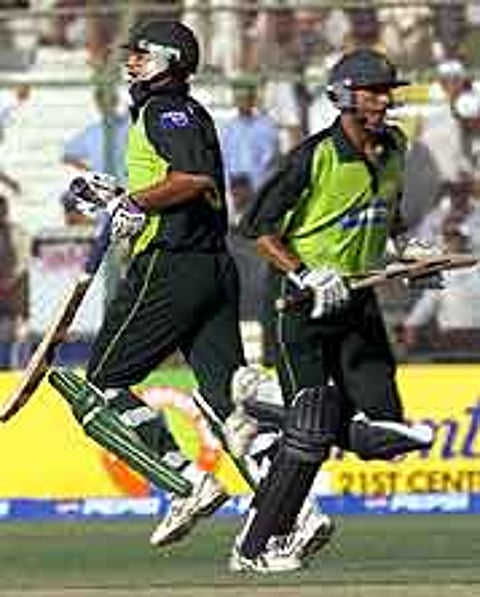
The great fight-back by Pakistan was led by a spirited captain's knock by man of the match Inzamam-ul-Haqwho made 122 runs in 104 balls and was involved in two century partnerships - 135 runs in 20 overs with YousufYohana (3-169, 27.4 overs) and 109 runs in 14.3 overs with Younis Khan.
Apart from Inzamam (Inzi bhai, as Rahul Dravid is shown referring to him, while affectionately, ifcheekily, replying to his captain that the tiffin he is carrying is filled with aaloo parathas for thePakistan captain, in the latest cold drink ad during breaks), Yousuf Yohana who made 73 runs in 67 balls andYounis Khan (46 runs in 48 balls), it was Abdul Razzaq's 27 runs in 16 balls and Moin Khan's 16 in 17 ballsthat were responsible for the Pakistan fight-back.
In fact, just before Razzaq got out (46.2 overs), Pakistan seemed comfortably placed at 322 with only 28runs required to win in 22 balls, and 5 wickets in hand. Anything was possible, but Pakistan seemed morefavourably placed to win the match. It seemed that despite having made 349 runs, it might just well be arepeat of the first practice game against Pakistan A at Lahore that India had lost despite making 335.
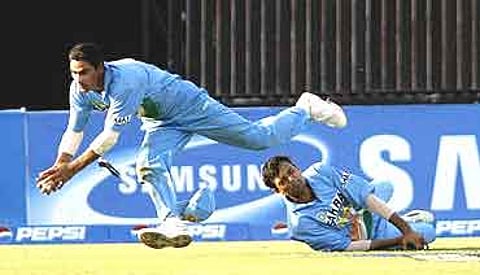
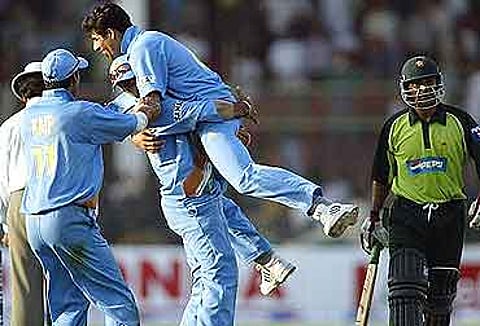
In many ways, Razzaq's wicket by Zaheer Khan (who returned with the best figures (3-66) was the turningpoint, but that as any body watching the match would testify is a highly debatable point when the match goesto the last ball. Before that, when just two overs were left, Pakistan required 17 runs and Zaheer came in tobowl the penultimate over. But the 5th ball of the 49th over - Zaheer's last - there was a scramble and clashon the field between Hemang Badani and Mohammed Kaif when both ran and dived for a skier by Shoaib Malik (7runs, 5 balls). In the end, Kaif came out triumphantly scooping and holding the ball up. Suddenly, Pakistanwere 7-340 with only 7 balls to go. Zaheer's last ball gave one more run and the last over left Pakistanrequiring 9 runs.
That the last over was bowled by Ashish Nehra is a testimony to the faith this young Indian team has in itsplayers and to back them. The man who had hit that memorable six against India to win the match for Pakistanat Sharjah, many years ago, now the coach of Pakistan, Javed Miandad, stood outside wildly gesticulating tothe Pakistani batsmen in the end who sure must have been distracted by their coach's exhortations and demonstrationsof the strokes that ought to have been or be played.
Advertisement
The pair ultimately fell short of the target which could have eclipsed the previous highest run chaserecord of Australia who had scored 330 for seven against South Africa in Port Elizabath in 2001-02. But all inall, it was a batting feast for the spectators - a world record of 693 runs were made on a day ofscintillating batting by the two sides.
Ashish Nehra's last over in many ways symbolised this new team India's nerves of steel. 9 runs to win,three wickets in hand. And he gave only three runs in his first five balls, each ball resulting in sighs ofrelief and dejection from respective fans. Anything could happen. The last ball required Pakistan to make 5runs to tie and 6 runs to win. Moin Khan, in the end, holed out to Zaheer Khan. It was over.
Apart from the fact that India held their nerves after putting up their highest ever score againstPakistan, despite the impressive fightback by Pakistan, in many ways the pre-match hype about the famedPakistani bowling is belied by the five extra overs they allowed Indian batsmen. Out of a total extras of 38runs in the Indian innings, as many as 30 came in the form of 10 wides and 20 no-balls. That is, full 30 ballsor 5 overs. As against this, the relatively inexperienced Indian bowling, despite the battering they took andthe pressure they came under when Inzy and Youhana were in full flow, gave away only 9 balls extra. That, inmany ways, was the deciding factor between the two teams - a more disciplined performance by Indian bowlersand some spirited batting by all.
Advertisement
India's Highest Ever Score Against Pakistan
Earlier, when India batted, Rahul Dravid missed his century by just one run as Indian batting might put upa dazzling display of strokes to record their highest total of 349 for seven against Pakistan.
Dravid led the Indian onslaught with a 104-ball 99 after Virender Sehwag (79 off 57 balls) had given histeam the perfect foundation with an array of strokes to leave the famed Pakistani bowlers in a complete daze.Captain Sourav Ganguly (45), Md Kaif (46) and Sachin Tendulkar (28) were the other notable contributors.
The Indian openers provided a blistering start to the innings as the Pakistan pacemen struggled to findtheir rhythm and were often guilty of overstepping the crease or bowling wide balls.
It was touted as a battle between Shoaib and Sachin. Shoaib Akhtar's first over itself yielded ten runs ashe bowled a couple of wides and no balls in a bid to generate extra pace on what looked like a very goodbatting track. The two openers had their moments of luck before they launched a fierce assault on thePakistani new ball balls. Sehwag was dropped by Shoaib Malik in the short cover region when he had not yetopened his account, while Tendulkar was caught by Younis Khan at square leg off Akhtar only to find that itwas a no ball.
Advertisement
Sehwag forced the pace of scoring by clobbering Mohammad Sami for two consecutive boundaries while thelittle master also looked in ominous form with a flurry of attacking shots to take India to 50 in just 5.3overs. The twoput on 69 runs in just nine overs before Akhtar provided the first breakthrough for the hosts bycapturing the prized scalp of Tendulkar for 28 which came off 35 balls and contained four boundaries and asix.
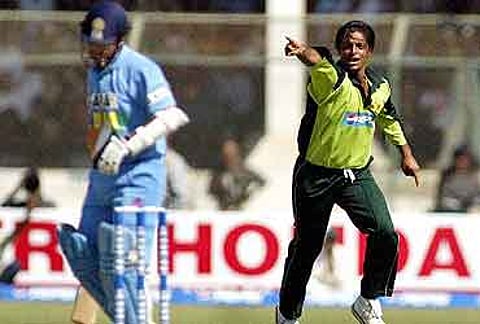
Sachin slashed at a widish ball and paid the price as he was caught by Rana Naveed-ul Hasan at gully muchto the delight of a vociferous home crowd watching the opening encounter of the historic series. Sehwag,undaunted as ever, went about the merry business of clobbering the bowling with some audacious strokeplay tonotch up his 13th half century in one-dayers.
The in-form Rahul Dravid, who joined the party after Sehwag's departure, started off with a delectableon-drive to the fence off Abdur Razzaq and then picked up the same bowler to smash two consecutive boundaries.Ganguly, who began a little tentatively, also grew in confidence in the company of his deputy and the twomaintained a brisk scoring rate.
Advertisement
With the runs coming easily, Pakistan captain Inzamam-ul-Haq introduced spinner Shoaib Malik in the 20thover but without much luck as Ganguly showed his aggressive intent by repeatedly going after the slow bowler.The captain and the vice-captain added 72 runs for the third wicket before Ganguly's stay at the middlewas brought to an end by Hasan.
The elegant left hander lifted Hasan for a six and went for another big hit in the very next ball butcompletely mistimed the ball as the bowler took a well-judged catch. His breezy 45 came off 47 balls andincluded three boundaries and two sixes. Hasan struck again for his team a few minutes later by claiming thewicket of the hard-hitting Yuvraj Singh for three with Yasir Hameed taking the catch.
Dravid and Mohammad Kaif, who had missed the tour of Australia due to finger injury, ensured that there wereno further setbacks by not taking any risks, being content in placing the balls in the gaps and running wellbetween the wickets. The pair stitched 118 runs for the fourth wicket before Dravid was bowled, playing onwhen just one short of what would have been a well-deserved century. His knock of 99 came off 104 balls andwas studded with eight boundaries.
India had begun well, scoring their highest ever total against Pakistan eclipsing the 316 for seven theymade in Dhaka in 1998.
In reply, the two Pakistani openers Yasir Hameed and Imram Farhat began a little cautiously and werelooking to settle down when Balaji, who opened the bowling for India from the far end, sent back Hameed with agem of a delivery.
Hameed played over the line of an incoming delivery from Zaheer to be bowled for just seven much to thedelight of the Indians who desperately needed an early breakthrough.
His opening partner Farhat joined him in the pavilion two runs later as he edged an outside the off-stumpdelivery off Zaheer Khan and Rahul Dravid made no mistake behind the stumps. He scored 24 off 29 balls. Therest, as you know from above, is history.
Published At:
Tags