When Outlook and Open magazines carried the transcripts of the Niira Radia tapes in 2010, it showed a new low in Indian journalism. Several Indian journalists were heard discussing with an influential and charismatic PR person how to assist corporate and political parties with their various agendas, which included choosing the telecom minister and interfering in a family feud over a captive gas resource. Since then, journalists have been called “presstitutes”, “newstraders”, purveyors of “paid news” and far worse. Media credibility is not in a happy place.
Medium Is A Mess
Traditional media is yet to limber up, the net pushes the limits

Therefore, it is very tempting to argue that the media in India is on a downward spiral. Certainly, 2014 was a watershed year: a test, if you will, of not just integrity, but of a basic understanding of what the media does. And yet, oddly, the media is more powerful and talked about than before.
The 2014 general election was a landmark not just because Narendra Modi took the BJP to a majority in the Lok Sabha or that anti-incumbency reduced the Congress to its lowest tally ever. It was a landmark for the media as well: would it remain a cheerleader for the new dispensation in power as it had been during the election or would it point out flaws where it saw them? Intriguingly, the same Modi who effectively used the media to push his development agenda in campaign mode has since shut the media out. Many in the media will bear the shame of still playing town-crier for a government that refuses to speak to them. The Editors’ Guild even went as cringingly far as to beg the PM for access.
Clearer than before was the corporate-political nexus to control the media. Soon after the election results were known, Mukesh Ambani’s Reliance Group announced that it was buying Network18, the media group with properties like CNN-IBN, IBN7, CNBC, Forbes and the websites Firstpost and Money Control. Speculation had been rife that something was afoot, with stories in Caravan magazine and the website Scroll, suggesting that the premier English news channel was being forced to become “right wing”; the company’s news and opinion website Firstpost had already obliged in that regard.
Besides, general gossip indicated that Ambani had supported Modi as prime ministerial candidate, so the change in Network18 seemed justified. Meanwhile, founder Raghav Bahl watched his empire vanishing and CNN-IBN editor-in-chief Rajdeep Sardesai resigned and his wife and fellow TV anchor Sagarika Ghose joined the Times of India. But even the Ambanis might like to remember from their earlier foray into the media with the Business and Political Observer that the beast is not always easy to handle.
Advertisement
It was not just the English media which was under attack. Mamata Banerjee and the Trinamool Congress in Bengal are in a running battle with the Ananda Bazaar Patrika group. The same ABP Group was also seen as anti-CPI(M) earlier, so is the TMC’s animosity one more childish expression of a deep persecution complex? In newly formed Telangana, chief minister K. Chandrasekhara Rao threatened journalists and media houses who were “anti-Telangana” with bodily harm. He was forced to retract but the veiled threat to free speech was evident.
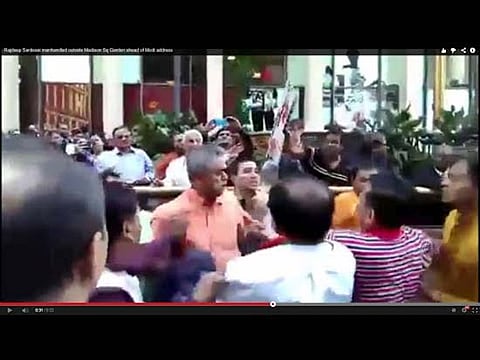
How have editors and journalists fared since May 2014? Television, for the most part, has remained a cheerleader. With pom-pom-waving NDTV and Headlines Today anchors around, Modi’s US tour and his Madison Square Garden song-dance-and-speech-athon needed no PR companies to spread the word. Ironically, it was Rajdeep Sardesai who provided some competition to Modi as far as social and mainstream media coverage was concerned. His run-in with Modi-BJP fans in New York almost derailed the apparent media oath of Nonstop Modi Coverage No Matter What.
Advertisement
As the year went on, senior journalists took selfies with the PM and flaunted their proximity to the powerful on social media. Or at any rate, their fan status. Times Now’s Arnab Goswami remained the loudest ‘outrager’ on everything, a rare sign that some things would never change, God was in his heaven and all was right with the world. Karan Thapar took his sharp tongue and no-nonsense approach from CNN-IBN to Headlines Today. Shekhar Gupta quit The Indian Express after 19 years, joined his alma mater India Today for two months and is now starting something of his own. Sardesai has a show on Headlines Today, nudging Rahul Kanwal off prime time. Headlines Today, for instance, offsets Kanwal’s breathless excitement over the new government and Gaurav Sawant’s proud “patriotism” with Thapar and the excellent cartoon series So Sorry, which pokes fun at all politicians.
So maybe everything is all right in the world? Someone, somewhere in the media remembers that our primary role is not to be the cheerleader but the annoying thorn in the side? There’s enough evidence that the scale tips towards neutrality over fantasy fandom. New websites like Scroll, Quartz and DailyO forced Firstpost to present a more balanced picture. Huffington Post has arrived as well. Print did not or could not become outright cheerleaders like TV. Columnists swung all ways, but now, after seven months, even longtime and newbie Modi supporters are asking searching questions of the government.
Advertisement
Opinions are being made and battles are being lost on social media as well. For 2015, if you as a media house or a media person are not out there, you’ve lost already. The mighty Times of India found out just how powerful Twitter can be after a tweet about a film star’s cleavage earned it international scorn. The biggest threat to traditional media—print and TV—still comes from the digital world. But that is now not just because of accessibility; it’s more because the internet demands that you do not pull your punches. It supports and nurtures a wider range of ideas than any time- or space-bound entity can. Yes, there is hatred, anger and rubbish floating about. Yes, the due diligence and rigour of good journalism can never be underestimated. But the digital space embraces that as well.
And for some of us in the media who bought into a mirage, 2015 offers a chance at redemption as well. Ironically, it is the journalists who most lionised the PM who are being ignored. Perhaps they need to relook at the word “newstrader” that Modi himself used and wonder who it applies to.
Advertisement
(Ranjona Banerjee, a senior journalist, writes on the media, politics and social trends.)
Published At:
Tags