UPA's Supporting Cast And Their Demands
Support Circus
The UPA is in a limbo over the N-deal. Its survival is being decided in the treacherous back alleys of Indian politics.

Samajwadi Party:
- Apart from an advantageous seat-sharing arrangement in Uttar Pradesh for the Lok Sabha polls, SP wants cases against its chief Mulayam Singh Yadav and his son Akhilesh dropped. It has already indicated that it will be asking for policy changes in the petroleum and telecom sectors, which could be aimed at adversely affecting corporate rivals.
Rashtriya Lok Dal:
- A seat-sharing arrangement in Uttar Pradesh for Lok Sabha polls and cabinet berths
Janata Dal(S):
- Still bargaining
Telangana Rashtriya Samiti:
- Promise of a Telangana state
Jharkhand Mukti Morcha:
- Ministerships at the Centre. It has also opened negotiations with the BJP.
***
P
But as the UPA braces itself for the trust vote later this month—announced after the PM met President Pratibha Patil on July 10, hours after his return from Japan—the party's political managers have their work cut out for them. From July 8, the day the Left reduced the UPA government to a minority, the party is getting used to a newly assertive Manmohan, clearly a step ahead of his cabinet and party colleagues. It is also coming to terms with having to produce the magic figure that will restore the majority—and the credibility—of the UPA government.
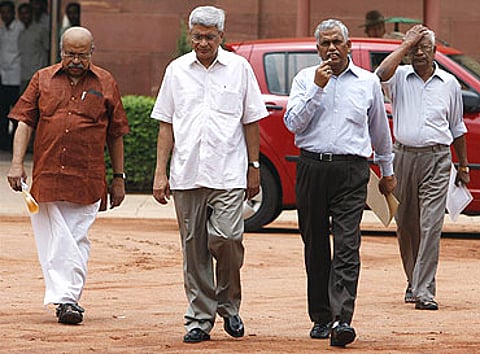
Out, out: Left leaders after executing their long-drawn threat of withdrawing support
After the Left's exit and the SP's offer to fill the breach, Congress president Sonia Gandhi called a meeting of her closest advisors—external affairs minister Pranab Mukherjee, defence minister A.K. Antony and her political secretary Ahmed Patel. Simultaneously, a meeting of the Cabinet Committee on Political Affairs was called to decide on suitable dates for Parliament's monsoon session. And anticipating nervous moments in the House, Congress floor managers—an eye glued to the TV for SP general secretary Amar Singh's every action—were checking lists, counting heads and coming up with a new figure every time.
The SP had committed its 39 MPs to the UPA, and so had some others, to make up the shortfall caused by the exit of the Left's 59-strong contingent. But later SP did not look in a position to deliver all 39—Munawwar Hussain had moved closer to the BSP; Jaiprakash Rawat was on TV declaring his intention to vote against the UPA; Atiq Ahmed and Afzal Ansari were both in jail and arrangements would have to be made to bring them to Parliament. The only solace was that Raj Babbar and Beni Prasad Verma announced that, despite having quit the SP, they would back the UPA government.
Faced with reports of desertions to the BSP, the SP leadership hastily called a meeting of its parliamentary party group in the capital for a show of strength. A nervous Amar Singh sought to refute reports that Muslims had not taken kindly to the SP's change of heart. This despite his own MP Shahid Siddiqui's newspaper Nai Duniya running a survey that Muslims were opposed to the deal. One senior MP admitted that the SP was working hard to keep the flock intact.
The long-ignored smaller parties, too, are seeing an opportunity to drive a bargain with the Congress. For instance, the three-member JD(S)—now reduced to two, with its MP Veerendra Kumar deemed unattached and supporting the Left—was recalling with bitterness how no senior Congress leader had been willing to meet its emissary who bore a letter of support for the UPA in 2004 or helped make its secretary-general Danish Ali a Rajya Sabha MP. Even UPA members such as the five-member Jharkhand Mukti Morcha opened a line to the BJP, thinking of the future as it was no longer represented in the Union council of ministers.
There was some good news from the one-MP PDP: though it withdrew support to the Congress-led government in J&K, it announced it would back the UPA. And the eight-member Shiromani Akali Dal appeared to be veering towards abstention: party sources said it was wary of being seen as voting against a government headed by the country's first Sikh PM.
Meanwhile, at the Congress HQ, all discussion seemed to centre on whether the UPA should itself initiate a trust vote at a special session or wait for an opposition party to move a non-confidence vote. Most party activists seemed to feel that unless the president explicitly directed the government to prove its majority, it would be tactically smarter to let the opposition move a no-confidence motion: it would force the Left to support the BJP or vice-versa, and that could prove useful in the elections.
B
ut suddenly all that was resolved: at the end of the CCPA meeting, Pranab announced that the government had decided to go for a trust vote before proceeding to the IAEA—and that he had the PM's approval to say so. Responding to speculation that the US had asked the government to prove its majority before moving forward on the deal, sources close to the PM said: "No, there's no such condition—the Americans have always asserted they can deal with any duly constituted government, minority or otherwise. But the PM feels it would increase India's credibility internationally if the government that asks for clearance of its safeguards agreement at the IAEA and then an nsg waiver has a majority."And, even as the fast-paced events on Raisina Hill unfolded on TV screens across the country and Congress leaders were keeping their fingers crossed on the numbers game, a subplot played itself out. Pranab, the party's man for all seasons, as chairperson of the UPA-Left coordination committee, had told the Left that a final call on the IAEA would be taken at a meeting on July 10 after the PM returned from Japan. But on July 7, the PM announced, en route to Japan, that he would be going to the IAEA "soon". A miffed Left said there was no point in having another meeting and pulled out support the next day.
Then, on July 8, Pranab announced that the government would seek a trust vote before going to the IAEA. By July 9, it was clear the government had already asked the IAEA to circulate the draft safeguards agreement—shielded from view as a "privileged document" in India—among its members in preparation for the meeting of the board of governors. Not just that, an IAEA spokesperson told The Hindu that while the IAEA secretariat could not have made the document public till India asked for it to be shown to IAEA members, India had been free all along to show it to anyone it wished to, implying the government had been less than transparent when it had said it could not show the Left leaders the document, pleading it was classified till the board of governors approved it.
Taken together, the two clearly undermined Pranab's position: the Left seized its opportunity, and said his position was "untenable". An embarrassed government went into damage control again, fielding in quick succession Congress media chairperson Veerappa Moily and Union science & technology minister Kapil Sibal to clarify that there was no contradiction between what Pranab had said and what had happened. Circulating the draft was not the same as seeking the approval of the board of governors, Sibal said, adding pointedly that once the Left had withdrawn support, the government was free to do whatever it wished. Moreover, he said that Pranab had spoken to the PM on July 8 and been authorised to move the IAEA.
For the Congress, these have been trying days, as it faces flak from the Left at its "betrayal" of the people and fire from the BJP which has been accusing it of indulging in "horsetrading". Not to mention dealing with difficult new partners. A pro-deal cabinet minister said frankly, "We will have to accustom ourselves to the prospect of the SP 'running' the government for the rest of our tenure." Worse will be the constant threat of a no-confidence motion—according to the Constitution, more than one no-confidence motion can be moved in one session, provided it relates to a different subject. That, of course, would be the ultimate nightmare for the party's managers. But that's the price for the promised nuclear renaissance.
Advertisement
Published At:
Tags