K
A Taste Of The Forbidden Fruit
Jammu's blockade has roused Kashmiris as never before. A look at the shades of wrath.

Bharat ragda
Bharat teri maut aye/Lashkar aye, Lashkar aye
I am served excellent salted tea at the very elegant home of Dr Shad Salim Akhtar, the Valley’s top cancer specialist. He is joined by his son, a medical student. They both tell me Indian secularism is a sham "that has cheated Muslims of every right". How is Pakistan a success, I counter, where Muslim kills Muslim and it’s tribe against tribe? "Pakistan may not be run well but that is not the fault of the concept of an Islamic nation. It is held in high esteem by many of us because it was the only country created in the name of Islam," says Dr Akhtar.
The talk of Pakistan and an Islamic state can be misleading to an outsider. There has always been a constituency for Pakistan and Islam in Kashmir. But the real demand is azadi. And the real issue, Kashmiris say, is the Indian conduct in the Valley, now compounded by the Hindu politics of Jammu. Dr Akhtar likens Kashmir to a woman and asks: "What if a woman is kidnapped by a handsome man? Even if the man is better than her other suitor, would she choose the kidnapper?"
This time, the azadi volcano erupted after years of relative peace, economic growth and booming tourism. The initial catalyst may have been the Amarnath land transfer controversy. But the movement crystallised rapidly once the fragility of the link with India was driven home by the agitation in Jammu. People suddenly realised that one single road, just 16 feet wide in parts, was all that linked them to India. The trauma is deep for a region that once was part of the ancient Silk Route, linked to China, Central Asia, Afghanistan and Iran. Today, it is only through Jammu that the fruit and handicrafts of the Valley can be transported. At one level, the crisis is almost at an existential level for the tormented Valley.

Riding the surf: Kashmiri protesters arrive in the hundreds for the march to the United Nations office on August 18
From his magnificent residence on the top of a hillock, with sweeping views of Dal Lake, Governor N.N. Vohra is trying to manage the security arrangements for another mass procession. Should the forces be removed even though the protesters are heading for the UN office in the heart of Srinagar? "We are in a terrible dilemma all the time though we are trying to minimise the conflict and have decided against imposing curfews since people only break them," he says. Isn’t the state government responsible for the mess? "Mistakes were made in handling the Amarnath issue. And the situation has not been helped by the attacks on Muslims in Jammu. They may be just a few incidents but they lead to a great feeling of insecurity in the Valley." That day the administration does indeed decide to keep the security forces only outside high security buildings. The protesters have a free run of Srinagar. They stream in from villages and towns across the Valley shouting azadi slogans.
Advertisement

In the evening I visit Omar Abdullah, the young face of the great political dynasty of Kashmir. The protests in the street can be heard in his garden. Omar is reconciled to a long period of uncertainty and mass protest. He jokes about his own predicament and reflects on the mistakes that led to the current state of affairs. "The entire land issue was horribly mismanaged. And then the perception of the economic blockade was devastating even though we know it was not as bad as was first imagined. But the Centre only wakes up after a crisis has erupted in Kashmir." Can a party like the National Conference survive this tidal wave? "Parties and political survival are not the issue. We have to save Kashmir. A situation like this cannot be managed. We can only try to respond in a reasonable manner," he says.
There is a mood of great depression in the Srinagar home of Union minister for water resources Saifuddin Soz. He blames the BJP for the mess: "The RSS, VHP and BJP are spreading communal hatred in Jammu without a thought for the consequences in Kashmir," he says. What of the Congress ineptitude and reluctance to take any stand vis-a-vis Jammu and Kashmir? Soz is first silent and then says it is hard for the Congress to do a balancing act in the year of a general election. What of elections in Kashmir that were due by end October? "Elections are not possible in the forseeable future although the BJP would like to have them as they feel they can exploit the mood in Jammu," he says. But he does have a view on the critical issue of security agencies and the handling of large protests. "One thinking has emerged that there is a lesser price to pay if a peaceful march is allowed rather than impose a curfew, especially when there is no guarantee that it will not be violated, and end in the killing of some people."
Advertisement
The Indian army has always been the enemy in Kashmir. But what is new and insidious is the communal element that has crept into the debate. Poet Zarif Ahmad Zarif is the chairman of the Valley’s citizen’s council. He makes the point that even during the worst years of violence, even hardliners did not speak a communal language. "But after what has happened in Jammu, people have begun to believe this is part of a Hindu conspiracy. They say even the Indian press sees Kashmir through Hindu eyes." Isn’t there an Islamic dimension to the movement? The reply is forceful: "Let me tell you that no one from the intellectual class wants Pakistan or an Islamic state. We know some people raise these slogans, but their numbers are small and their politics are a misfortune for the Kashmiri people."
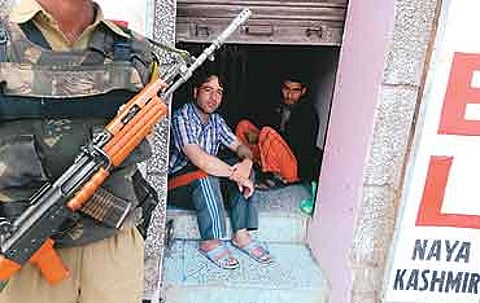
Today, the original azadi hero, jklf leader Yasin Malik, may share the platform with Syed Ali Shah Geelani, the hardliner who believes in an Islamic state. But Malik continues to propound his secular ideology. He says that in Kashmir there has never been intellectual justification for communalism. "But in Jammu, the Pandits are all educated and they have joined the intellectual stream that is rabidly anti-Muslim. This will have a long-term impact on the politics of the entire state. I am deeply worried about this process of communalisation." What of revolution? "There is a romanticism of youth and the events have given them a fiery idealism. We can only try to channelise the energy," he says.
Advertisement
Indeed, Dr Noor Ahmad Baba, dean, faculty of social sciences, and professor of political science at Kashmir university, says that many did not expect this generation to be more radical than previous generations. "We had thought there was some degree of fascination and admiration for Indian accomplishments," he says. But he believes the entire Amarnath controversy was an attempt to change the course of history. "Just as Israel said that Palestine is a holy land, the Hindu right says that part of Kashmir is their holy land."
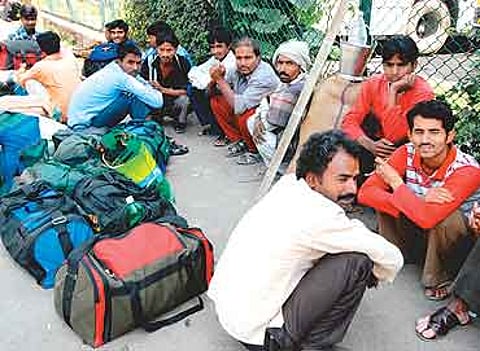
Turmoil: As protests gather steam, Bihari labourers prepare to leave
Yet Baba says there are steps that can be taken to cool tempers. There is after all a strong economic constituency that seeks ties with India. The day after the Srinagar march, we drive out into the orchards near Sopore. Farmer after farmer claims to be indifferent to azadi. Abdul Majid Dar, an orchard owner in Boschu village, Pattan, says with a smile: "We want fruit, not freedom." Mohammad Akbar, a transporter from the New Kashmir Truck Union, too echoes this view: "Here we are all fed up. We have suffered losses. We want life to be normal." Abdul Majeed, another orchard owner, says that freedom is useless if the fruit rots. "In these parts it is only the students and some young men who don’t understand life who are shouting slogans. We are worried as we have debts to pay and our labour force will starve. Freedom would be nice but not if all the fruit rots."
Advertisement
Already, the price of protest is being counted. And many Kashmiris may be content to work out an honourable peace with India. But the problem perhaps lies in the fact that the discourse on Kashmir is either based on deliberate falsehoods or being driven by a dangerous ignorance. For instance, Kashmiris complain that ever since the mass movement erupted in the Valley it has been suggested that it is to counter the "nationalist" Hindus of Jammu, and that Kashmiris have again revealed their "separatist" tendencies. The truth is Kashmiris have no hesitation in claiming they would prefer independence to India. Hence calling them separatist is no insult.
But they do have a problem with the Indian media and political parties presenting their movement as a "Muslim reaction" to a Hindu demand for land allotment at a pilgrimage site. In fact, their biggest concern is that they will just be used as a pawn between rival political parties in India during elections. There is also the fear of simply being ignored, which may drive them to greater madness.
By Saba Naqvi in Srinagar with Showkat A. Motta
Published At:
Tags